
Zcash Vulnerability Exposes Privacy vs Auditability Trade-Off | Why Bitcoin’s Transparent Ledger Is Its Greatest Strength
The Trade-off Nobody Talks About
You can have perfect privacy on a blockchain. You can hide every transaction, obscure every balance, and make the ledger completely opaque. But when you do that, you lose something terrifyingly important.
You lose the ability to verify the supply.
With Bitcoin, you can run a node on an old laptop in your basement. In no-time, you can verify with mathematical certainty that exactly 21 million coins exist. No backdoors. No hidden inflation. No trust required.
Privacy coins like Zcash and Monero? They claim to verify supply too. But their methods are Byzantine labyrinths of cryptography and trusted setups. You can’t just “check” like you can with Bitcoin. You have to believe. You have to hope the math holds. You have to trust that nobody found a bug.
And on May 29, 2026, that trust cracked wide open.
When Orchard Bled
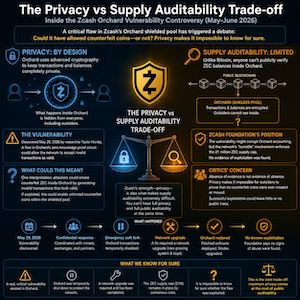
Taylor Hornby, a security researcher with a reputation for finding what others miss, discovered a critical vulnerability in Zcash’s Orchard shielded pool. This wasn’t some minor bug. This was in the zero-knowledge proof circuit itself, the mathematical heart of Zcash’s newest privacy system.
Here’s what that means in plain English.
The network had been accepting transactions as valid when they weren’t. Invalid shielded transactions—potentially ones that created ZEC out of nothing—looked legitimate to the protocol. The code couldn’t tell the difference between real coins and counterfeits.
The Zcash developers went into emergency mode. They coordinated secretly with miners, exchanges, and infrastructure providers before going public. They activated an emergency soft fork that kneecapped Orchard entirely, disabling those transactions while scrambling to patch the rest.
A permanent fix required a full network upgrade because the vulnerability was baked into Orchard’s proving system itself.
The Supply Cap That Couldn’t Promise
Now comes the nightmare scenario that keeps cryptography experts awake.
Critics argue this was a hidden inflation bug. Someone could have exploited this flaw to generate counterfeit ZEC inside the Orchard pool, creating new coins that the network would recognize as valid. The supply would quietly balloon beyond the promised 21 million cap, diluting everyone’s holdings.
The Zcash Foundation disputes this interpretation. They argue their accounting mechanisms would still enforce the 21 million cap even if Orchard’s internal math went sideways. They call it a serious consensus flaw, not a supply threat.
But here’s where the story gets truly disturbing.
Orchard is designed specifically to hide transaction details and balances. Unlike Bitcoin, where every satoshi is publicly auditable, Orchard operates in cryptographic darkness. This means there is currently no public evidence that the vulnerability was exploited. But—and this is crucial—there is also no straightforward way to prove it was never exploited.
The Zcash Foundation says they found no signs of abuse. Critics fire back that absence of evidence is not evidence of absence. In a privacy-preserving system where exploitation leaves no public trace, how would you ever know?
You wouldn’t.
Why Bitcoin Chose Transparency
This is exactly why Bitcoin made the choice it did. Yes, the transparent blockchain enables surveillance. Yes, those analytics companies can trace flows and build heat maps of economic activity. Bitcoiners hate that too.
But you know what you can do with Bitcoin?
You can verify the supply down to the last satoshi. Anytime. Anywhere. By yourself. No trusted setups. No complex cryptographic ceremonies. Just raw math that a teenager can audit.
The Verification Problem That Never Goes Away
Monero fans have long criticized Zcash as a “corporate fake-privacy coin.” And yes, the corporate structure and trusted setup ceremonies raise legitimate concerns.
But the deeper issue transcends any single privacy coin. When verification requires complex cryptographic proofs rather than simple observation, certainty becomes probabilistic. You might have sophisticated methods to verify supply. You might have trusted audits. But you can never achieve the same guarantee as running a Bitcoin node and counting 21 million for yourself.
If a vulnerability exists that could inflate supply — and that exploitation might not be visible on-chain — you have a fundamental architectural problem. Bitcoin nodes give you maximal certainty against counterfeiting. Privacy coins give you complicated verification with inherently less certainty.
The Real Privacy Solution
But you’re not stuck choosing between surveillance and secrecy. This is where the “there are no solutions, only trade-offs” principle actually works in your favor.
Bitcoin solves privacy on second layers.
Lightning Network on a self-custodial wallet gives you privacy for your daily coffee run. These transactions don’t hit the blockchain. They don’t leave a permanent trail. High adoption of non-custodial Lightning would gut the mass surveillance infrastructure without touching Bitcoin’s supply integrity.
Then there’s Cashu. We’re talking extreme privacy here—cash-level anonymity with offline transactions possible. It’s as private as physical paper money.
The catch? You have to trust the mint. Just like you trust a bank to hold your dollars.
But here’s the beautiful part. Cashu is evolving fast. Unruggable mints are nearly reality. And because Cashu operates as a layer on top of Bitcoin, the base layer remains auditable. If the mint fails, you still have the Bitcoin supply cap protecting the underlying asset.
The Painkiller vs The Cure
Privacy coins are offering you a painkiller for a symptom. They’re masking the surveillance problem while introducing a potentially fatal disease—uncertain monetary supply.
Mass surveillance is a fiat symptom. It thrives in a world of infinite money printing and debased currencies. Fix the money, and you fix the root cause of the surveillance state.
Bitcoin’s strict scarcity is the cure. When we transition to a Bitcoin standard, the economic surveillance apparatus loses its oxygen. The incentives shift from tracking and controlling every penny to simply holding sound money.
Private transactions serve an absolute need right now. In this crazy fiat world where governments print trillions overnight, protecting your financial privacy matters. It’s not optional. But trading away the one feature that’s actually going to kill fiat—hard cap verifiability—is cutting off your leg to cure a headache.
The Verdict
Zcash proved the critics right within days. The emergency soft fork. The coordinated hiding of information before disclosure. The impossibility of proving the supply wasn’t inflated in private.
These weren’t conspiracy theories. These were necessary responses to a vulnerability that sat undetected until Taylor Hornby found it.
You can’t have maximal privacy and maximal auditability on the same base layer. The math doesn’t allow it.
So choose carefully.
You can have a coin where anyone can verify the supply right now, and you can add privacy on top through Lightning and Cashu. Or you can have a privacy coin where the supply might already be compromised, and you’d never know.
There are no solutions. Only trade-offs. Make sure you’re trading for the right thing.