
Why BIP110 Is a Slippery Slope That Could Harm Bitcoin
I spent yesterday listening to Wicked’s spaces. Today I watched Mechanic on What Bitcoin Did. Two sides. One debate. And a sinking feeling that we’re walking into a trap.
Here’s the thing. I was undecided on the filter debate for months. I genuinely didn’t know where I stood. I do understand the Core argument, but the arguments of the filter crowd make a lot of sense too. Then BIP110 dropped. And everything clicked into place.
This isn’t about spam. It’s not about inscriptions. It’s about who gets to decide what Bitcoin is allowed to do, which can turn out really badly later down the line
The Slippery Slope Nobody’s Talking About
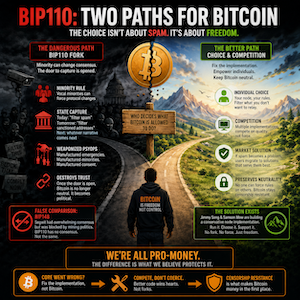
BIP110 proposes letting a minority of node runners change Bitcoin’s consensus rules. The idea is that game theory will push it through, even if the majority doesn’t agree with it. That might sound harmless. It isn’t.
Once you open that door, state actors will be watching and it will start raining psyops to do exactly that. Today it’s “filtering spam.” Tomorrow it’s “filtering sanctioned addresses.” Next year it’s whatever narrative the next psyop cooks up to manufacture a new minority with a new emergency.
This will be weaponized. When you create a mechanism where vocal minorities can force protocol changes, you don’t get better Bitcoin. You get capture.
I agree with almost everything Mechanic said about the problems. The spam is real. The incentives are distorted. Bitcoin Core took a wrong turn somewhere. But BIP110 is not the cure. It’s a more dangerous disease wearing a doctor’s coat. It’s an attack on the most important features of Bitcoin.
The False Comparison to BIP148
Mechanic made a striking claim on the podcast. If BIP110 fails, nodes don’t matter anymore. The next halving becomes uncertain. Bitcoin’s future hangs in the balance.
I want to push back. But not the way Danny rightfully did. I agree with his argument that miners would not have an incentive to destroy the value prop of their own source of income, but I think the following argument is much more important:
Remember BIP148? Everyone wanted Segwit. Everyone. Only the miners with AsicBoost advantages didn’t want it. Some big blockers blocked it for political reasons. But the community consensus was overwhelming. Even Roger Ver thanked Core developers for building Segwit, calling it amazing technology. He just blocked it anyway because of politics.
Segwit was in high demand, but held hostage by big blockers for political reason. BIP148 was the tool to break through this. To enable an upgrade with consensus that was blocked by a combination of a flaw in mining equipment and politics.
That’s completely different from BIP110.
In 2017, almost everyone wanted Segwit. In 2026, almost nobody wants BIP110. Comparing these two is misleading at best.
The July Timeline That Undermines Itself
Mechanic said something interesting about timing. Nobody needs to care right now. But come July, everything comes to a head. People will be forced to choose sides because then their money is on the line.
Wait a minute.
Doesn’t that completely undermine his own argument? He keeps saying nobody is really against BIP110 because he doesn’t see a URSF yet. But if the urge to care only starts in July , how can he claim there’s no opposition now? Could it be that the opposition just doesn’t care enough yet to launch an URSF?
The Better Solution Already Exists
Mechanic floated a hypothetical. Maybe something better than BIP110 could come along. Some alternative that achieves the same goals without the same risks.
It’s already here.
Jimmy Song and Samson Mow are working to bootstrap a conservative node implementation right now. This isn’t theoretical. It’s happening. And it solves his moral issue that he don’t want to relay spam on his own node, without forcing other people by touching consensus.
Here’s how it works. People run this alternative node. They reject spam locally on their own machine. Their node, their rules. No force. No fork. No coercion. No censorship.
BIP110 is censorship at the protocol level. Running your own filtering node is choice at the individual level on your own property. One imposes. The other empowers.
If Mechanic’s prediction comes true, if more spam floods the network and node operators feel the pain, the market can react naturally. People migrate to the conservative implementation because it serves their needs. Not because someone forced them. Because they chose to. Obviously this solution is much more in line with the Bitcoin ethos and way less risky for the Bitcoin project.
Core Went Wrong. So Fix the Implementation.
The whole BIP110 debate started with a legitimate grievance. Bitcoin Core, as an implementation, went in the wrong direction. They allowed standards that opened the floodgates to arbitrary data. They didn’t protect the monetary use case strongly enough. However I understand their arguments, they should at least have kept the option to filter.
But here’s what I don’t understand.
If your ship has a leak, you fix the ship. You don’t try to drain the ocean. Forking Bitcoin because you don’t like Core’s policy decisions is exactly that kind of misdirected nonsense. Fix the implementation with competition, don’t try to change Bitcoin. You know most Bitcoiners hate people who try to change their precious Bitcoin. Especially without consensus!
Core is one implementation. Competitors can exist. Bitcoin Knots already does. This new conservative implementation from Song and Mow will too. Push for serious competition at the implementation level. Let the market decide which node software wins.
That’s how you fix the issues you have with Core, not by forcing a minority fork through everyone’s throat.
The False Narrative About “Believing in Bitcoin as Money”
I’m tired of this talking point from the BIP110 crowd.
“We believe Bitcoin is money. The 110 skeptics don’t.”
Stop. Both sides believe Bitcoin is money. The difference is philosophical, not about belief.
BIP110 proponents think restricting the blockchain to purely monetary use is the most important way to preserve Bitcoin’s moneyness. They see data storage as a threat to the core function.
Skeptics like me believe censorship resistance is what makes Bitcoin money in the first place. Without permissionlessness, you have PayPal with extra steps. Without the ability to use the chain however you want provided you pay the fees, you have a managed network subject to capture.
We’re both pro-money. We just disagree on what is most important to keep our money sound.
The Epstein Connection Nobody Wants to Discuss
Mechanic mentioned Epstein near the end of the podcast. Some think Epstein’s influence is pushing one side of this debate.
I think we need to take this seriously. But I see something darker.
What if Epstein’s goal isn’t about which side wins? What if the division itself is the attack? What if the fork, and the chaos it could cause exactly what they wanted all along?
Follow the money. Epstein invested in Coinbase. Epstein invested in Blockstream. Those two entities represented both sides of the block size war in 2017. Both sides.
Now look at today. Peter Thiel was close to Epstein. Thiel’s company is invested in Citrea. And his previous employee is pushing hard for BIP110.
Both sides again?
The Epstein files revealed Epstein worked for the Rothschilds. You know what they’re famous for? For hundreds of years? Funding both sides of wars.
This pattern should terrify you.
If we fork Bitcoin over BIP110, if we permanently damage some of Bitcoin’s basic promises, we might be giving them exactly what they want. My call to every Bitcoiner, on whatever site you are: Let’s resolve this without without hostile forks! We are all Bitcoiners who want Bitcoin to win as money!
The Choice Is Yours
Listen to Wicked’s spaces. Watch Mechanic on What Bitcoin Did. Listen to the Coretards, the Knotzi’s and the neutral Bitcoiners. Hear both sides with an open mind, believe me both have good arguments so we don’t have to hate each other.
Then ask yourself one question.
Do you want a Bitcoin where consensus changes require overwhelming agreement? Or one where motivated minorities can force their vision on everyone else?
The first path is hard. Slow. Frustrating. But it keeps Bitcoin free.
The second path is a conveyor belt to capture. It will invite psyop after psyop to create these cultist minorities.
Choose carefully. The next halving isn’t at stake here. Bitcoin’s censorship resistance and decentralization is.